
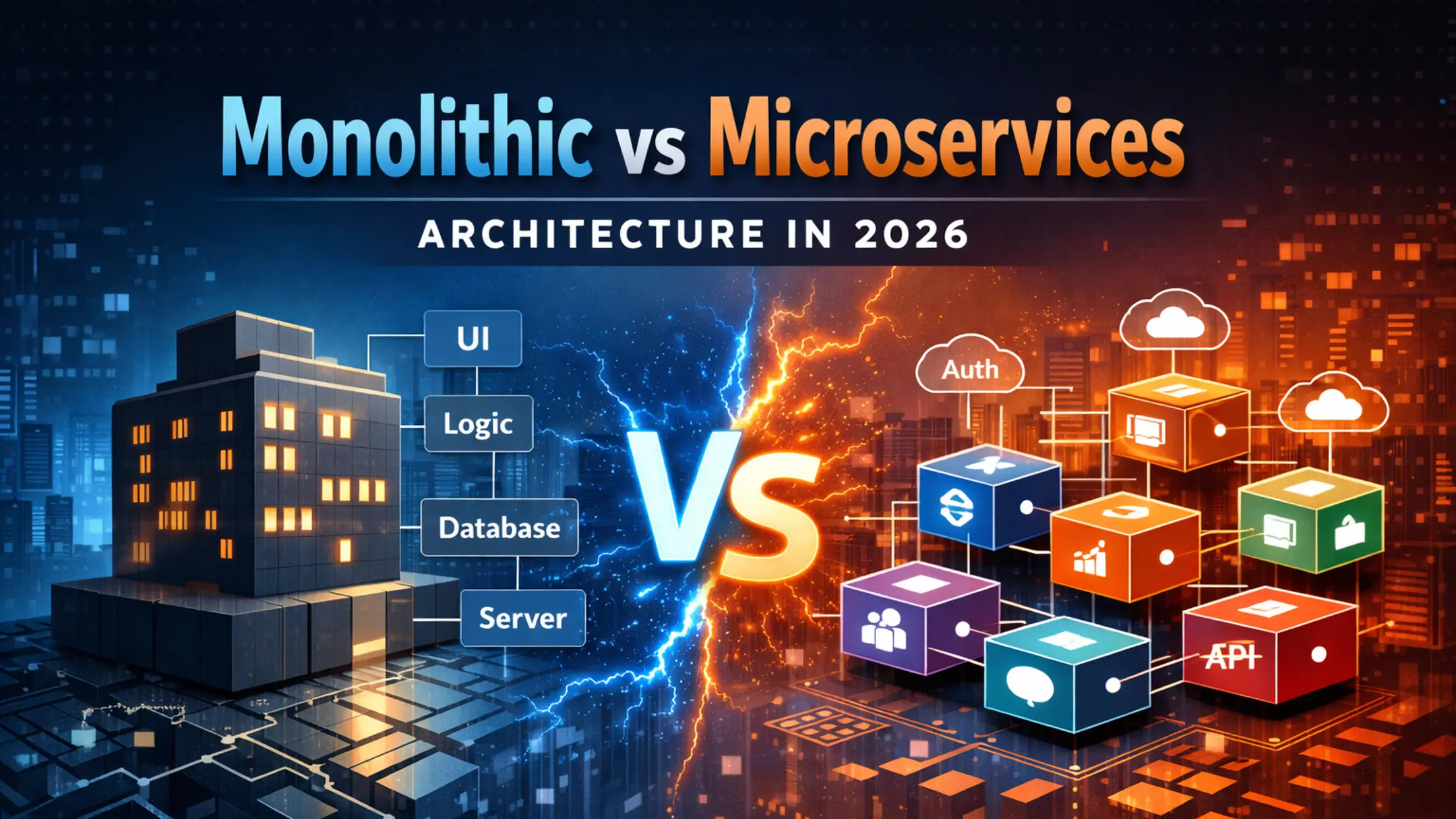
In 2026, software architecture decisions are more critical than ever. With AI-powered platforms, cloud-native tools, edge computing, and rapidly scaling startups, choosing between Monolithic and Microservices architecture can either accelerate growth-or quietly slow everything down.
For years, microservices were hyped as the ultimate solution, while monoliths were often dismissed as “old-school.” But the reality in 2026 is far more nuanced.
This guide breaks down what each architecture really offers today, their pros and cons, and when you should choose one over the other.
What Is Monolithic Architecture?
A monolithic architecture is a traditional software design where the entire application is built as one single unit. All components-UI, business logic, database access-are tightly coupled and deployed together.
Key Characteristics
-
Single codebase
-
Single deployment unit
-
Shared database
-
Simple communication within the app
Example
A small SaaS app where user authentication, payments, admin dashboard, and APIs all live in one application.
What Is Microservices Architecture?
Microservices architecture breaks an application into independent, loosely coupled services. Each service handles a specific business function and can be developed, deployed, and scaled independently.
Key Characteristics
-
Multiple small services
-
Independent deployments
-
Service-to-service communication via APIs or events
-
Decentralized data management
Example
An eCommerce platform where user service, payment service, inventory service, and recommendation engine are all separate systems.
Monolithic vs Microservices: Core Differences (2026 View)
| Aspect | Monolithic | Microservices |
|---|---|---|
| Deployment | Single deployment | Independent deployments |
| Scalability | Vertical scaling | Horizontal, service-level scaling |
| Development Speed | Faster initially | Faster long-term for large teams |
| Complexity | Low | High |
| Cost | Lower | Higher (infra + ops) |
| Fault Isolation | Weak | Strong |
| Best For | Startups, MVPs | Large-scale, complex systems |
Why Monolithic Architecture Still Makes Sense in 2026
Despite all the buzz around microservices, monoliths are far from dead.
Advantages of Monolithic Architecture
1. Faster Time to Market
If you’re building an MVP or early-stage product, monolithic architecture lets you move fast with fewer decisions and less overhead.
2. Easier Development & Debugging
With everything in one place, testing, debugging, and understanding the codebase is simpler—especially for small teams.
3. Lower Infrastructure Cost
No need for service meshes, API gateways, observability stacks, or complex DevOps pipelines.
4. Ideal for Small Teams
In 2026, many successful startups still begin with monoliths because they optimize for speed and clarity, not complexity.
Limitations of Monoliths
-
Harder to scale specific features
-
Large codebases become difficult to manage over time
-
One bug can affect the entire system
-
Slower deployments as the app grows
Why Microservices Dominate at Scale in 2026
Microservices truly shine once complexity and scale increase.
Advantages of Microservices Architecture
1. Independent Scalability
You can scale only what you need. For example, scale the payment service during sales without touching the rest.
2. Faster Innovation with Large Teams
Multiple teams can work in parallel without stepping on each other’s code.
3. Better Fault Isolation
If one service fails, the rest of the system can continue running.
4. Technology Flexibility
Different services can use different languages, frameworks, or databases.
5. Cloud & AI Friendly
Microservices integrate better with:
-
AI/ML pipelines
-
Event-driven systems
-
Edge computing
-
Multi-cloud strategies
Challenges of Microservices
-
High operational complexity
-
Requires mature DevOps & monitoring
-
Network latency issues
-
Higher cloud costs
-
Overkill for small applications
The 2026 Reality: Modular Monoliths & Hybrid Approaches
In 2026, many companies are choosing a middle path:
Modular Monolith
A single deployment but with well-separated internal modules, making it easier to split into microservices later.
Hybrid Architecture
Core system remains monolithic, while high-scale or high-risk features are extracted into microservices.
This approach balances speed, cost, and future scalability.
When to Choose Monolithic Architecture in 2026
Choose Monolithic if:
-
You are building an MVP or startup product
-
Team size is small (1–10 developers)
-
Budget is limited
-
Product requirements are still evolving
-
Speed matters more than scalability
-
You want simpler DevOps
Rule of thumb: If you don’t need microservices yet, don’t build them.
When to Choose Microservices Architecture in 2026
Choose Microservices if:
-
You have a large engineering team
-
Application handles high traffic or global users
-
Business domains are complex
-
You need independent scaling and deployments
-
Downtime is extremely costly
-
You already have strong DevOps practices
Rule of thumb: Use microservices to solve real scaling problems, not hypothetical ones.
Final Verdict: Monolithic vs Microservices in 2026
There is no one-size-fits-all answer in 2026.
-
Monolithic architecture wins on simplicity, speed, and cost.
-
Microservices architecture wins on scalability, resilience, and long-term flexibility.
The smartest teams start simple, validate the product, and evolve architecture only when the business demands it.
Frequently Asked Questions (FAQs)
1. Is monolithic architecture outdated in 2026?
No. Many modern, high-performing applications still use monolithic or modular monolithic designs successfully.
2. Can a monolithic application be scaled?
Yes, through vertical scaling and optimization, but it has limits compared to microservices.
3. Are microservices always better for performance?
Not necessarily. Network communication between services can introduce latency.
4. Is microservices architecture expensive?
Yes. Infrastructure, monitoring, DevOps tooling, and cloud costs are higher.
5. Can I migrate from monolith to microservices later?
Absolutely. Many companies start with a monolith and gradually extract services.
6. What is the biggest mistake teams make?
Choosing microservices too early without the team, scale, or need to support it.
7. What architecture is best for startups in 2026?
A monolithic or modular monolithic architecture is usually the best starting point.

admin
Content Writer and Specialist.