
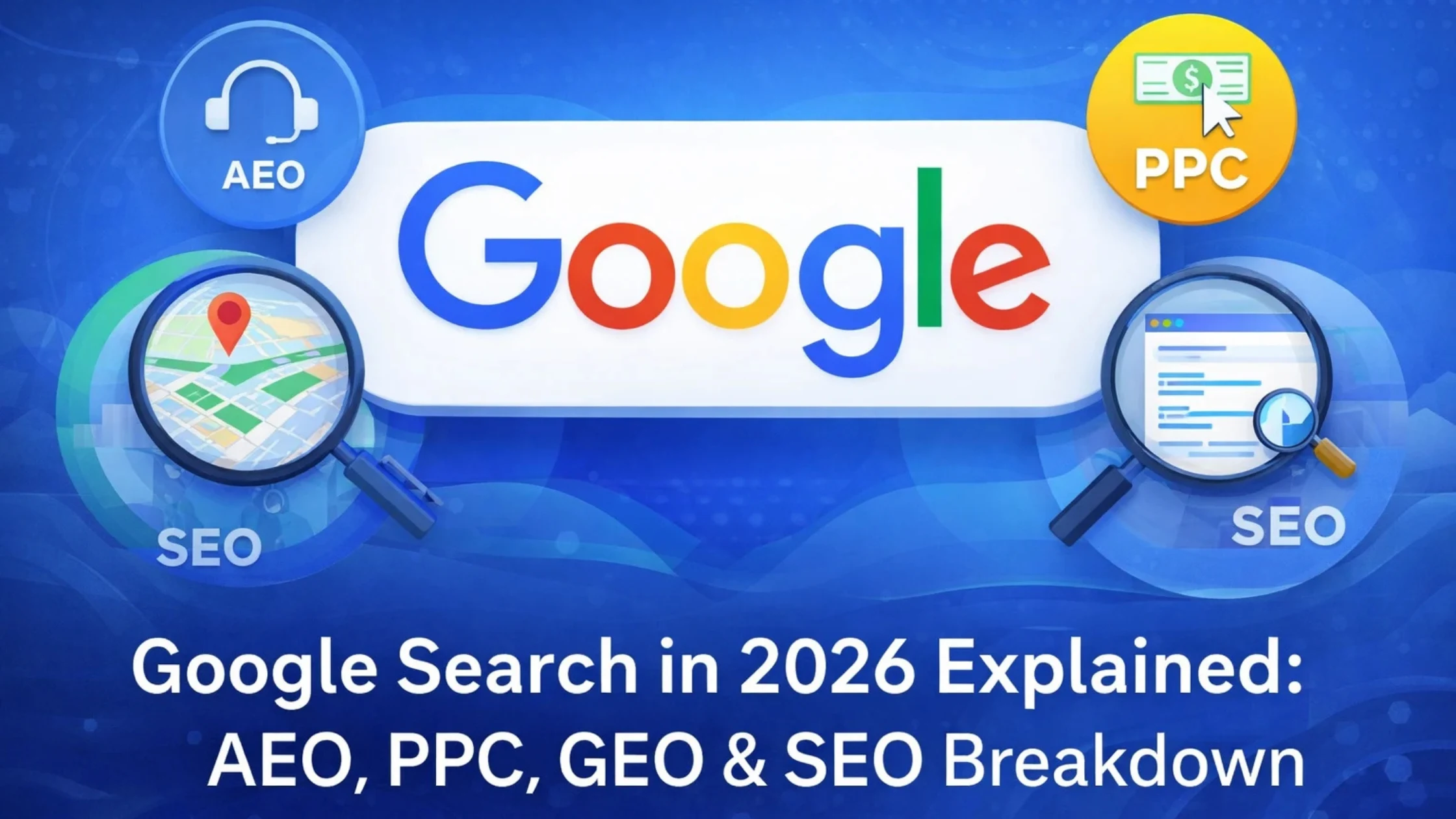
For years, ranking on Google meant one primary goal: get to the first page through SEO.
If you optimized your content well, built backlinks, and followed Google’s rules, organic traffic followed. But that version of Google
Search is officially outdated.
In 2026 and beyond, when a user searches for a keyword, Google doesn’t simply display a list of websites. Instead, it dynamically decides who deserves attention first, based on:
-
Search intent
-
User location
-
Commercial value
-
AI-generated relevance
-
Paid vs organic competition
Today, a single keyword can trigger four completely different search layers:
-
AEO – AI Overview
-
PPC – Paid Ads
-
GEO – Local / Maps Results
-
SEO – Organic Listings
This shift has fundamentally changed how visibility, traffic, and conversions work.
SEO alone is no longer enough.
Let’s break down each layer and understand how the new Google Search ecosystem really works.
1: AEO – AI Overview (The Zero-Click Era)
What Is AEO (AI Overview)?
AEO stands for Answer Engine Optimization.
Google’s AI Overview (powered by generative AI) now appears at the very top of many search results. Instead of sending users to websites, Google often answers the query directly.
Example searches triggering AI Overview:
-
“What is risk management software?”
-
“Best CRM for small businesses”
-
“How to apply for a student visa”
Google scans multiple sources, summarizes them, and presents a single AI-generated answer.
Why AEO Is Dangerous for Traditional SEO
-
❌ Fewer clicks to websites
-
❌ Users get answers without scrolling
-
❌ Even #1 ranked pages may get ignored
This is called zero-click search — and it’s growing rapidly.
How to Optimize for AEO
To survive AI Overview, content must be AI-friendly:
✔ Clear, structured answers
✔ FAQ-style content
✔ Schema markup (FAQ, HowTo, Article)
✔ Short, authoritative paragraphs
✔ Data-backed explanations
Pro Tip:
If your content helps Google explain something clearly, AI is more likely to cite or reference it.
2: PPC – Paid Ads (Pay to Be Seen)
Why PPC Dominates High-Intent Searches
For commercial keywords, Google prioritizes revenue.
Searches like:
-
“Buy CRM software”
-
“Study abroad consultants near me”
-
“Best insurance policy India”
These almost always show Google Ads before anything else.
Even before AI Overview, ads often appear first.
The Reality of PPC in 2025
-
Ads take prime screen space
-
Mobile users may see only ads initially
-
Organic results get pushed further down
-
CPCs are rising due to competition
But PPC offers instant visibility, something SEO cannot guarantee.
Smart PPC Strategy (Not Just Spending Money)
✔ Use PPC for high-conversion keywords
✔ Retarget organic visitors via ads
✔ Combine PPC data to improve SEO strategy
✔ Focus on landing page quality & intent match
SEO brings trust. PPC brings speed.
In 2025, brands need both.
3: GEO – Local / Maps Results (Location Wins)
What Is GEO (Local Search Optimization)?
GEO focuses on location-based intent.
Searches like:
-
“Digital marketing agency near me”
-
“Best café in Shimla”
-
“Visa consultant in Delhi”
These queries trigger Google Maps + Local Pack results.
Even the best SEO article won’t rank here unless you have a strong local presence.
Why Google Business Profile Matters More Than SEO
Google prefers:
-
Verified local businesses
-
Real reviews
-
Accurate NAP (Name, Address, Phone)
-
Active profiles with photos & updates
For local intent, Google Business Profile (GBP) beats traditional SEO.
How to Win GEO Rankings
✔ Optimize Google Business Profile
✔ Collect genuine reviews regularly
✔ Add services, images, posts
✔ Use local keywords
✔ Maintain consistency across directories
If your business is local, SEO without GEO is wasted effort.
4: SEO – Organic Listings (Still Important, But Lower)
Is SEO Dead? Absolutely Not.
SEO is still the foundation of digital visibility.
But it now competes with:
-
AI answers
-
Ads
-
Maps
-
Videos
-
People Also Ask
Organic listings are often below the fold, especially on mobile.
What Modern SEO Looks Like in 2026
Old SEO focused on:
-
Keywords
-
Backlinks
-
Rankings
New SEO focuses on:
✔ Search intent
✔ Topical authority
✔ E-E-A-T (Experience, Expertise, Authority, Trust)
✔ Content depth
✔ Multi-format visibility (text, video, FAQ)
SEO now feeds AI, PPC, and GEO, not just rankings.
5: How One Keyword Triggers All 4 Layers
Let’s take an example keyword:
“Best Study Abroad Consultants”
Google may show:
-
AI Overview: List of top factors & providers
-
PPC Ads: Sponsored consultants
-
Maps Results: Nearby agencies
-
SEO Results: Blogs, comparison guides
If you rely only on SEO, you’re competing for the last visible slot.
6: Why SEO Alone Is No Longer Enough
The Hard Truth
-
AI steals informational clicks
-
Ads dominate commercial intent
-
Maps win local searches
-
Organic links get limited attention
Businesses that rely only on SEO will see:
❌ Declining traffic
❌ Lower CTR
❌ Reduced visibility
The New Winning Strategy: Search Presence Optimization (SPO)
Instead of SEO alone, brands must optimize for:
✅ AEO – Be AI-answer friendly
✅ PPC – Capture buying intent
✅ GEO – Own local searches
✅ SEO – Build authority & trust
This is the new Google Search Reality.
7: How Businesses Should Adapt in 2025
Action Plan
✔ Create AI-ready content (FAQs, summaries)
✔ Invest in Google Ads strategically
✔ Optimize Google Business Profile
✔ Build brand authority beyond rankings
✔ Track visibility, not just positions
Conclusion:
Google Search is no longer a list of websites.
It’s an AI-powered decision engine that decides:
-
Who answers
-
Who advertises
-
Who appears locally
-
Who ranks organically
In 2025 and beyond, visibility means owning multiple layers, not just SEO.
SEO is still important — but it’s no longer the whole game.
The brands that win will be those who understand and optimize for the full Google Search ecosystem.

admin
Content Writer and Specialist.